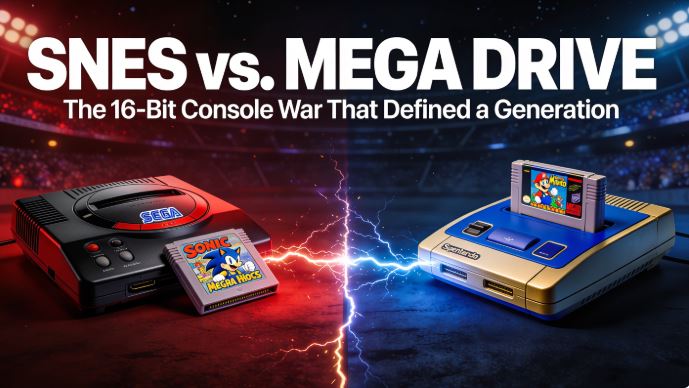
Few rivalries in history have sparked as much passion as the battle between the Super Nintendo Entertainment System (SNES) and the Sega Mega Drive (known as the Genesis in North America).
From 1989 to the mid-1990s, these two consoles fought for the living rooms, and the hearts, of an entire generation of gamers.
This wasn't just a competition between two companies. It was a cultural war that shaped the entire gaming industry as we know it today.
The Origins of the Rivalry
The Sega Mega Drive launched in Japan in 1988, then hit North America in 1989 as the Sega Genesis, at a time when Nintendo's 8-bit NES still dominated the market. Sega's bold move was to go 16-bit first, giving players a taste of arcade-quality graphics at home — and it worked. The Genesis had a two-year head start before Nintendo responded.

👉 See the Mega Drive 2 16-bit Retro Console
Nintendo's answer arrived in 1990: the Super Famicom in Japan and the Super Nintendo in North America and Europe in 1991. By then, Sega had already established itself as a credible challenger, and the stage was set for one of the most legendary console wars in history.
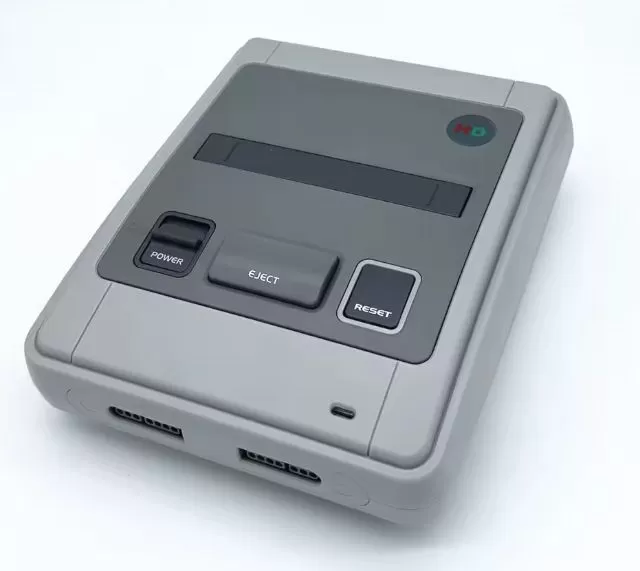
👉 See Super Nintendo Retro Console
Hardware: Who Had the Better Machine?
The two consoles took very different technical approaches, each with its own strengths and weaknesses:
| Feature | SNES | Mega Drive / Genesis |
|---|---|---|
| CPU | Ricoh 5A22 @ 3.58 MHz | Motorola 68000 @ 7.6 MHz |
| CPU Speed | Slower | ~2x Faster ✅ |
| Colors on screen | 256 from 32,768 palette ✅ | 64 from 512 palette |
| Resolution | Up to 512×478 | Up to 320×224 |
| Sound chip | Sony SPC700 (8-channel) ✅ | Yamaha YM2612 (FM) |
| Special features | Mode 7, Super FX chip ✅ | Blast Processing (marketing) |
| RAM | 128 KB | 72 KB |
The Mega Drive's Motorola 68000 CPU ran at 7.6 MHz, making it nearly twice as fast as the SNES's processor — which is why Sega's marketing team coined the famous (and partly exaggerated) term "Blast Processing".
However, the SNES countered with superior color depth, its innovative Mode 7 pseudo-3D rendering technology, and a significantly better sound chip designed by Sony.
Both consoles also had expansion capabilities: the SNES had the Super FX chip (used in Star Fox/Star Wing), while Sega offered the Sega CD add-on and later the 32X.
The Sales War: Who Won?
The numbers tell an interesting story, and the answer varies by region:
-
Worldwide: SNES sold 49.10 million units vs. Mega Drive's 30.75 million — a clear Nintendo victory.
-
North America (USA): Much closer — SNES ~20 million vs. Genesis ~18.5 million. Sega dominated for years before Nintendo caught up.
-
Europe: The Mega Drive was the dominant console throughout most of the early 1990s.
-
Japan: Nintendo crushed Sega, with the Super Famicom virtually unchallenged.
-
Software sales: Surprisingly, the Mega Drive sold 576 million games vs. the SNES's 378 million, largely because of Sega's stronger North American and European performance during the console's peak years.
Verdict: Nintendo won the global sales war, but Sega won the battle in Western markets for much of the generation — especially in Europe, where the Mega Drive was a cultural phenomenon.
The Exclusive Games Battle
This is where things get truly heated. Both consoles had phenomenal exclusive libraries that are still celebrated today.
🎮 Best SNES Exclusives
The SNES was home to some of the most critically acclaimed games in history:
-
Super Mario World — The greatest platformer of its time, bundled with the console
-
The Legend of Zelda: A Link to the Past — Widely regarded as one of the best games ever made
-
Chrono Trigger — A JRPG masterpiece that still tops "greatest games of all time" lists
-
Final Fantasy VI — Perhaps the greatest Final Fantasy ever made
-
Super Metroid — Defined the Metroidvania genre
-
Donkey Kong Country — Used pre-rendered 3D graphics that shocked the industry
-
F-Zero — A launch title that showcased Mode 7 in breathtaking fashion
-
Star Fox (Star Wing) — The first game to use the Super FX 3D chip
-
Super Mario Kart — Invented the kart racing genre
-
Street Fighter II Turbo — The best home version of the arcade classic
🎮 Best Sega Mega Drive / Genesis Exclusives
Sega's library leaned towards fast-paced action, arcade ports, and edgier content:
-
Sonic the Hedgehog (1, 2, 3 & Knuckles) — The face of an entire generation
-
Streets of Rage 2 — One of the greatest beat-em-ups ever made
-
Gunstar Heroes — A chaotic, brilliant run-and-gun from Treasure
-
Comix Zone — A wildly creative side-scroller with a unique comic book aesthetic
-
Castlevania: Bloodlines — The only Castlevania on the platform, and arguably one of the best
-
Phantasy Star IV — The definitive Sega RPG of the era
-
Contra Hard Corps — The hardest and most intense Contra ever made
-
Ristar — A late gem that showcased what the hardware could really do
-
ToeJam & Earl — One of the most unique co-op experiences of the era
-
Ecco the Dolphin — A hauntingly atmospheric adventure unlike anything else
The Defining Battles: Games Both Had
Some of the most heated arguments came from multiplatform games where both consoles had their own version. The differences were often dramatic:
🥊 Mortal Kombat (1993) — Round 1 Goes to Sega
This was Sega's greatest victory in the console war. Nintendo censored the blood in its SNES version, replacing it with grey "sweat". The Mega Drive version kept the blood — players just had to enter a code (ABACABB). The result? The Genesis version significantly outsold the SNES version, and it became a defining moment in the rivalry.
🥊 Street Fighter II — Round 1 Goes to Nintendo
The Mega Drive originally had only a 3-button controller, which made Street Fighter II awkward to play. The SNES version with its 6-button layout was far superior, driving massive SNES sales. Sega eventually released a 6-button controller, but the damage was done.
🥊 Disney's Aladdin — A Tie (Different Games!)
Uniquely, both consoles had completely different Aladdin games — not ports of each other. The SNES version was developed by Capcom and features tight platforming mechanics. The Mega Drive version was developed by Virgin Games and allowed Aladdin to use a sword. Both are excellent — and both are considered classics.
Sega's Bold Moves & Nintendo's Responses
The rivalry wasn't just about hardware and games — it was a war of marketing, attitude, and strategy.
Sega pioneered aggressive advertising, famously using the tagline "Genesis does what Nintendon't" — a direct attack on Nintendo that was unprecedented in the industry. Sega targeted older teenagers with edgier games and messaging, while Nintendo maintained its family-friendly image.
Sega also pushed hardware expansion faster than Nintendo, releasing the Sega CD in 1992 — which allowed CD-ROM games and full-motion video. Nintendo attempted a CD add-on with Sony, which famously fell apart and led directly to Sony creating the PlayStation. The rest, as they say, is history.
Why the SNES Ultimately Won
Despite Sega's early lead and Western dominance, Nintendo's combination of superior software depth, Japan dominance, and iconic franchises (Mario, Zelda, Final Fantasy) gave the SNES the edge globally. The SNES controller also proved far more influential — its layout of four face buttons and two shoulder buttons became the template for virtually every controller that followed, from PlayStation to Xbox.
Sega's aggressive expansion strategy — the 32X, the Sega CD, the rushed Saturn — ultimately fragmented its customer base and damaged consumer trust, while Nintendo took a more measured approach.
Where to Buy Them Today
Whether you want to relive the nostalgia or discover these classics for the first time, both consoles are widely available:
🛒 Buy a Retro SNES or Mega Drive
Original hardware (retro market):
-
Search eBay or local retro game shops for original SNES or Mega Drive consoles — prices range from €30–€100+ depending on condition and region.
Modern retro clones (play real cartridges via HDMI):
-
🔗 Retro-Bit Super Retro Trio Plus — Plays SNES, NES and Genesis cartridges in one console with HDMI output.
-
🔗 Hyperkin Retron 5 — One of the most popular multi-system retro clones available.
-
🔗 Sega Mega Drive Retro Clone (AliExpress) — Budget Mega Drive clones from ~$20–$50, great entry point.
-
🔗 RETROAD RD06C HD Ultra (Mega Drive cartridges) — Plays original Mega Drive carts via HDMI.
Mini consoles:
-
The Nintendo Switch Online service includes a growing library of SNES and Genesis games for subscribers.
The Legacy: 30 Years Later
The SNES vs. Mega Drive war never truly ended — it simply evolved into internet debates and passionate Reddit threads. Even in 2026, communities of dedicated fans continue to release brand new homebrew games for both platforms. In 2025 alone, over 17 new games were released for the Sega Genesis/Mega Drive by independent developers, proving that these systems are still very much alive.
The SNES produced some of the most enduring game franchises in history, while the Mega Drive gave us Sonic, Streets of Rage, and an attitude that shook Nintendo out of its comfort zone. Without Sega's aggressive challenge, we might never have had the edgier, more adult games industry we enjoy today.
Both consoles are winners. The real victory was ours — the players.
Quick Verdict
| Category | Winner |
|---|---|
| Raw CPU speed | Mega Drive ✅ |
| Graphics & colors | SNES ✅ |
| Sound quality | SNES ✅ |
| Game library depth | SNES ✅ |
| Best sports/action games | Mega Drive ✅ |
| Best RPG library | SNES ✅ |
| Controller design | SNES ✅ |
| Western market presence | Mega Drive ✅ |
| Overall global sales | SNES ✅ |
| Cultural attitude | Mega Drive ✅ |
Which side were you on? Team Mario or Team Sonic? Let us know in the comments! And if you're looking for more retro console deep dives, check out our full guides on the best SNES games, best Mega Drive games, and the top retro gaming consoles you can buy today.