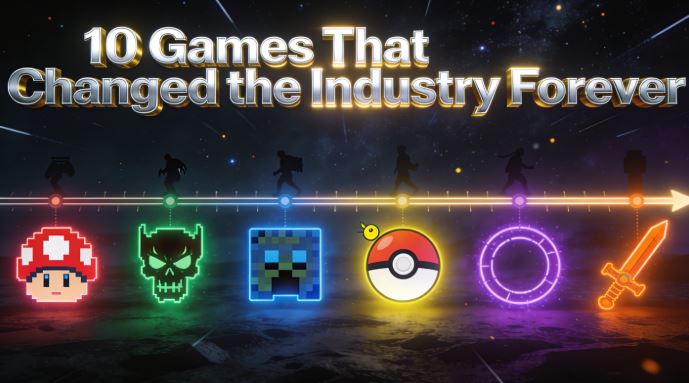
Every few years, a game arrives that doesn't just entertain — it rewrites the rules. It forces developers to rethink their craft, publishers to reconsider their strategies, and players to realize that gaming can do something it never did before.
These are not simply the "best" games ever made, though many qualify. These are the games that bent the trajectory of the entire industry. Before and after each one, gaming was genuinely different.
1. DOOM (1993)
Developer: id Software | Platforms: PC, and virtually everything since
Before DOOM, first-person shooters existed but were novelties. After DOOM, they became one of gaming's defining genres. Released in December 1993, id Software's masterpiece introduced real-time 3D graphics, atmospheric level design, and visceral gunplay that felt unlike anything players had experienced. You were a space marine fighting demons on Mars — and the world lost its mind.
But DOOM's influence extended far beyond its genre. It pioneered network multiplayer, letting players connect via LAN to frag each other in deathmatch — a concept that would eventually birth competitive online gaming as we know it. It popularized modding culture, giving players tools to build their own levels and spawning entire creative communities. It pushed the PC hardware race forward, turning graphics cards from curiosities into necessities. Franchises like Halo, Call of Duty, and Quake all owe their existence to DOOM. Even in 2025, DOOM: The Dark Ages is one of the most anticipated releases of the year — 32 years after the original.
2. Super Mario Bros. (1985)
Developer: Nintendo | Platforms: NES
In 1983, the video game industry collapsed. Flooded with terrible products and broken promises, consumer trust evaporated and the entire market cratered. Then, in 1985, Super Mario Bros. arrived on the Nintendo Entertainment System and single-handedly resurrected home gaming. Nintendo's gamble — betting the company on a plumber running through mushroom kingdoms — paid off in a way that reshaped global entertainment.
Super Mario Bros. established the foundational grammar of game design: responsive controls, escalating difficulty, hidden secrets, power-ups, and level structure that rewarded exploration. Every 2D platformer made in the following four decades traces its DNA directly back to this game. And when Super Mario 64 arrived in 1996 as the franchise's next revolution, it performed the same feat for 3D gaming — inventing the analog stick movement, camera control, and 3D level design conventions that every 3D game still uses today.
3. The Legend of Zelda: Ocarina of Time (1998)
Developer: Nintendo | Platforms: Nintendo 64
When Nintendo released Ocarina of Time in November 1998, they didn't just make a great game — they wrote the playbook for 3D adventure games that the industry still follows. As the first 3D entry in the Zelda series, it faced an enormous challenge: translating the series' deep exploration and puzzle-solving into three dimensions without losing its soul. It succeeded beyond anyone's expectations.
Ocarina introduced Z-targeting — the lock-on combat mechanic that allows players to focus on a specific enemy while moving freely — a system so intuitive that virtually every 3D action game since has adopted it. Its context-sensitive button system, huge interconnected world, and masterful musical mechanics set new standards for immersion and interactivity. BAFTA, WatchMojo, and virtually every major gaming publication consistently ranks it among the two or three most influential games ever made. Thirty years on, modern developers still cite it as a foundational reference.
4. Grand Theft Auto III (2001)
Developer: Rockstar Games | Platforms: PS2, Xbox, PC
GTA III didn't invent the open world — but it perfected it in a way that made everything before look primitive. When Rockstar released Liberty City in 2001, players suddenly had an entire living, breathing 3D city to inhabit. Not a corridor, not a hub world, but a place with traffic, pedestrians, radio stations, and emergent chaos that unfolded differently every time. You could ignore the missions entirely and simply exist in the city — a concept that felt genuinely radical.
The game's non-linear mission structure and freedom of approach influenced every open-world game that followed: Assassin's Creed, Red Dead Redemption, Cyberpunk 2077, Spider-Man, and dozens more. Its side-quest design — NPCs giving spontaneous jobs, ambient activities filling the world with purpose — became the template for open-world content design. GTA III proved that players didn't just want to play a story — they wanted to live inside one.
5. Final Fantasy VII (1997)
Developer: Square | Platforms: PS1, PC (and modern remasters)
Before Final Fantasy VII, RPGs were considered niche, text-heavy games for patient enthusiasts. After it, they were mainstream blockbusters. Square's decision to bring their beloved franchise to PlayStation — backed by Sony's aggressive marketing — exposed millions of players to deep storytelling, complex characters, and emotional narrative in a way gaming had never achieved before. The death of a major character midway through the game sent genuine shockwaves through the gaming world.
FFVII proved that video games could tell mature, cinematic stories that rivaled films in emotional impact. Its pre-rendered backgrounds, full orchestral score, and sweeping narrative ambition set a new benchmark for RPG production values. The game sold over 13 million copies and is widely credited with making the PlayStation the dominant console of its era. The ongoing Remake trilogy — still in progress — is a testament to how deeply this game embedded itself in gaming culture.
6. Minecraft (2011)
Developer: Mojang | Platforms: PC, then everything
Minecraft proved that a game made by one person in Java, with deliberately retro graphics, could become the best-selling video game in history — over 300 million copies sold across all platforms. Markus "Notch" Persson's sandbox survival game had no story, no objectives, and no hand-holding. Players were dropped into a procedurally generated world and left to do whatever they wished. The result was an explosion of creativity that no AAA studio had anticipated.
Minecraft fundamentally changed the industry's understanding of what games could be. It pioneered user-generated content at scale, with players building recreations of entire cities, working computers, and functioning calculators inside the game. It made the Early Access model viable — launching in unfinished form and iterating based on community feedback. It also bridged gaming and education, becoming a genuine classroom tool used in thousands of schools worldwide. Every sandbox, survival, and "create-your-own-world" game since owes a direct debt to Minecraft.
7. Street Fighter II (1991)
Developer: Capcom | Platforms: Arcade, SNES, and many others
Street Fighter II didn't just define the fighting game genre — it essentially created it in its modern form and saved the arcade industry for an entire decade. Before SFII, arcades were in decline. After it, arcades became packed social battlegrounds where players spent entire afternoons practicing combos and challenging strangers. The game's eight playable characters — each with distinct moves, backstories, and playstyles — established the template every fighting game has followed since.
SFII pioneered competitive gaming culture before esports had a name. Watching two skilled players battle was a spectator sport in itself, drawing crowds and building community. It introduced special move inputs (quarter-circle, charge motions) that became universal fighting game language. Mortal Kombat, Tekken, Soul Calibur, and every modern fighting game traces its lineage directly back to a Capcom arcade cabinet from 1991. The game sold over 15 million console copies — extraordinary for its era.
8. World of Warcraft (2004)
Developer: Blizzard Entertainment | Platforms: PC
When World of Warcraft launched in November 2004, MMORPGs existed — but none had achieved mainstream adoption. WoW changed that almost immediately. At its peak in 2010, it had over 12 million paying subscribers — a number that no online game had reached before and few have matched since. It became a genuine cultural phenomenon, referenced in South Park, news headlines, and academic papers about social behavior.
WoW redefined the business model for online games, proving that players would pay a monthly subscription for a persistent online world. Its deep quest systems, guild mechanics, and raid content created social bonds that lasted years. It also established the loot progression loop — killing bosses to earn better gear to kill harder bosses — that became the backbone of nearly every online game since, from Destiny to Diablo IV to The Division. When WoW eventually declined, it gave birth to the free-to-play revolution — but that revolution only happened because WoW proved online games could be a business.
9. Fortnite (2017)
Developer: Epic Games | Platforms: Multi-platform (PC, PS4/5, Xbox, Switch, Mobile)
Fortnite did not invent the battle royale genre, nor was it the first free-to-play game. But it combined both models with a cultural agility no other game has matched, becoming a $26 billion property and fundamentally reshaping how the industry thinks about monetization, live service, and gaming as a social platform. Epic pivoted from a co-op survival game to battle royale almost overnight in 2017 — and the gamble made gaming history.
The Battle Pass system Fortnite popularized — paying a seasonal fee for a cosmetic reward track — is now industry-standard across virtually every major live service game. Its in-game concerts (Travis Scott, Ariana Grande), movie tie-ins, and crossover events with Marvel, Star Wars, and NFL transformed a shooter into a living entertainment platform that blurs the line between game, social media, and pop culture event. For an entire generation of younger players, Fortnite isn't just a game — it's a place where they hang out.
10. Pokémon Red & Blue (1996)
Developer: Game Freak | Platforms: Game Boy
Pokémon Red & Blue arrived in Japan in 1996 and the rest of the world by 1998-99, triggering one of the most sustained entertainment phenomena in human history. The concept — catch, train, and battle 151 creatures across an RPG world, then trade them with friends via link cable — was elegantly simple and breathtakingly deep. Nintendo sold over 31 million copies of the original pair, making it the best-selling RPG on handheld at the time.
Pokémon's industry legacy is enormous. It proved handheld gaming could carry AAA-quality experiences, elevating the Game Boy from a toy to a serious gaming platform. It pioneered the concept of designed scarcity in games — making certain Pokémon version-exclusive to force social interaction and trading, a mechanic now fundamental to live-service and mobile games. And it created the template for the collect-and-battle genre that spawned Digimon, Yo-Kai Watch, Temtem, and Palworld, plus the mobile revolution triggered by Pokémon GO in 2016 — which made 800 million downloads and brought AR gaming to the masses.
Honorable Mentions
These titles came agonizingly close to the top 10 — each one reshaped at least one major corner of the industry:
-
Tetris (1984) — The first truly global gaming phenomenon, bridging every demographic and platform
-
Metal Gear Solid (1998) — Proved games could tell spy thriller narratives with cinematic depth
-
Half-Life 2 (2004) — Revolutionized physics-based gameplay and launched Steam, changing PC game distribution forever
-
Angry Birds (2009) — Dragged mobile gaming into the mainstream and built a $200M franchise
-
GoldenEye 007 (1997) — Brought multiplayer FPS to consoles for the first time, paving the way for Halo and CoD
-
Dark Souls (2011) — Created an entirely new design philosophy around intentional, rewarding difficulty
What These Games Share
Looking across all ten entries, a clear pattern emerges. Every game on this list did at least one of three things: it introduced a mechanic that became industry-standard, it expanded the audience for gaming in a meaningful way, or it launched a new business model that changed how games are sold and monetized. The best entries on this list did all three simultaneously.
Gaming's history is a story of successive revolutions, each one triggered by a single title with the vision — or the luck — to do something no one had done before. The next game to change everything is probably being developed right now, in a spare bedroom, by someone with an idea that sounds slightly absurd. Just like Minecraft. Just like DOOM. Just like Pokémon.
🎮 Stay ahead of gaming history with the ultimate setup: Gaming Accessories on AliExpress